A relative remembers “around nine in the morning,” but a chart form demands an exact hour. The easy mistake is to enter nine and then treat the detailed text that follows as a conclusion based on precise information. A page producing a result does not remove uncertainty from the birth record.
When reading traditional systems such as BaZi or Qi Zheng Si Yu, start by preserving the basis for your inputs. Their rules differ, but neither can turn an unknown time in the original evidence into a verified fact.
Separate what is remembered from what is inferred
Divide the available information into three columns: original records, relatives' recollections and your own guesses. A birth document giving a specific time differs in precision from someone remembering “just after dawn” many years later. If they conflict, preserve that conflict instead of choosing the answer you prefer.
For example, if the time can only be narrowed to 08:30–09:30, that is a one-hour range of possibilities. 09:00 is its midpoint, not a verified birth time. Even if the form temporarily accepts only one value, label it “demonstration input” in your notes. Do not copy it back into the evidence sheet as fact.
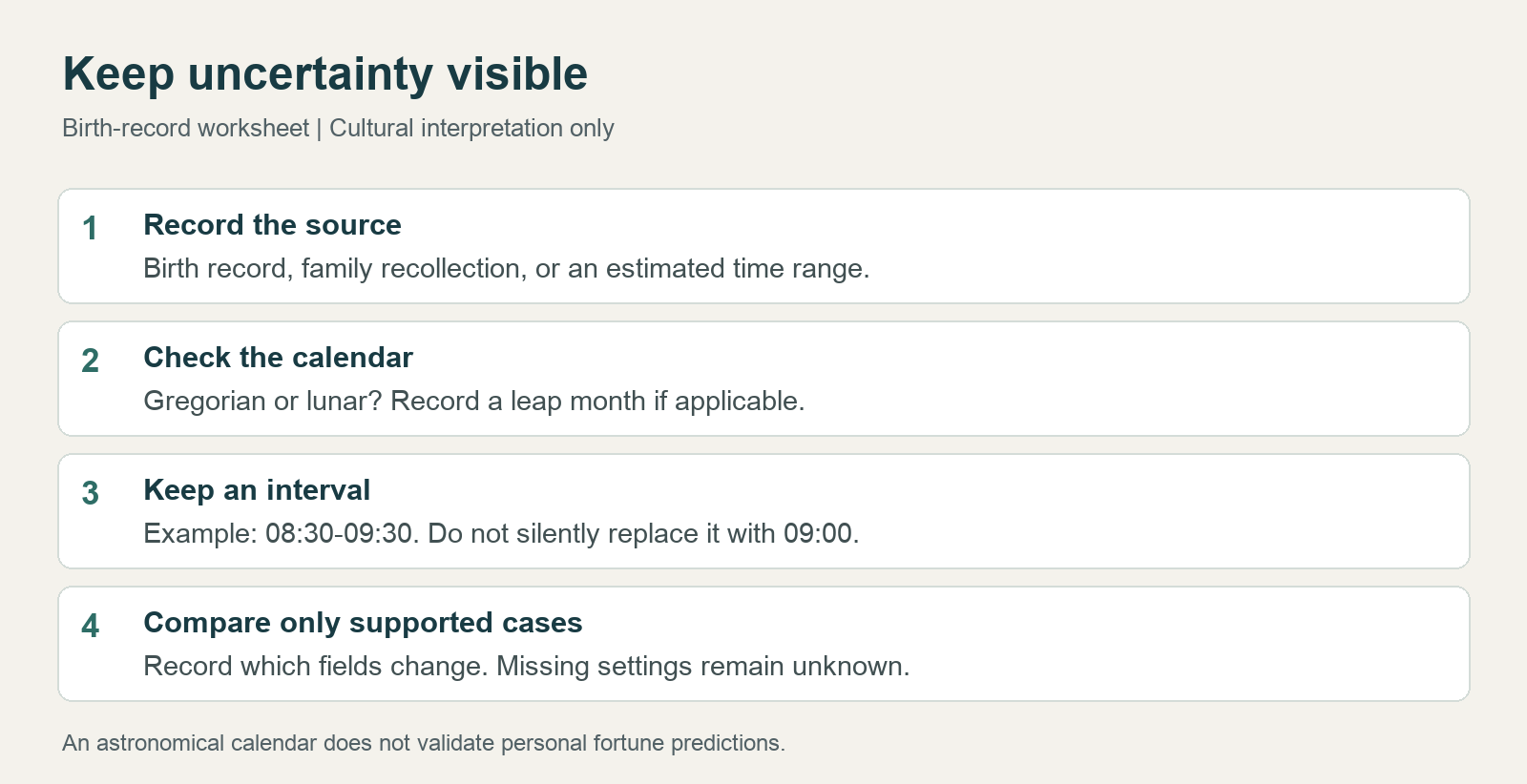
Figure: a workflow for checking birth information. The 08:30–09:30 interval is a fictional record example; no personal chart was generated.
Check the Gregorian and lunar dates before interpreting results
First check whether the form requires a Gregorian or lunar date, then establish which calendar the record uses. If a leap month is specified, do not keep only the month number. The Chinese input instructions previously checked for this site's Qi Zheng Si Yu tool require a Gregorian birthday down to the hour. That establishes the page's requirement, not how its backend handles other calendars or time settings.[2]
The Hong Kong Observatory provides Gregorian–lunar conversion tables for 1901–2100, a public reference for cross-checking dates.[1] Select the year before finding the date. These are calendar-conversion data, not validation of a charting system's interpretations of destiny.
The Observatory also explains that for distant-future calculations of lunar phases and solar terms close to midnight, uncertainty of a few minutes can shift the corresponding date by a day. That note has a specific scope of times and events. It does not mean “everyone's birthday might be one day wrong,” nor does it justify changing an already clear birth record.
When using a table, preserve the original date notation beside the converted Gregorian date and record the year of the table. A record saying only “the third day of the eighth lunar month,” without a year, cannot yield a unique conversion. For records near midnight, establish the place and timekeeping convention before deciding whether a date boundary is involved.
Record the time convention before comparing results
The birthplace, local civil time used in the record, historical daylight saving and whether the tool converts automatically may all affect how an input is understood. Mark unsupported or unclear settings “unconfirmed.” Do not assume that a page with no visible time zone has already handled everything.
Different traditions may use different day-change or double-hour boundaries. Before comparing two tools, check whether their visible settings agree. If settings are not disclosed, similar results do not establish identical algorithms, and different results do not prove that one tool must be wrong.
Some articles recommend correction to apparent solar time; others use civil time directly. This is not a matter of adding or subtracting one number that works for every system. Establish the time convention required by the system before converting. Otherwise, keeping the original time and the unknowns is more reliable than layering on corrections of uncertain origin.
Why a Hong Kong record from 1979 needs a daylight-saving check
The Hong Kong Observatory's historical table shows summer time from May 13 to October 21, 1979, one hour ahead of Hong Kong Standard Time. From 1980 onward, the table records no summer time.[4] Today's familiar time-zone setting therefore cannot simply be applied to a decades-old birth record.
Suppose a Hong Kong record dated July 1, 1979 gives 09:15 local clock time, and it is confirmed to have used the summer time then in force. Converting to Hong Kong Standard Time gives 08:15. Keep 09:15 as the original entry and add a separate note: “subtract one hour because of historical summer time.” Do not overwrite the source.
If the software automatically handles summer time from the birth date and place, do not subtract an hour manually and let it subtract again. If its behavior is unclear, retain the original civil time and consult the documentation. For the same date, a difference of exactly one hour is often worth checking for this kind of double conversion first. This example concerns timekeeping only; it produces no chart interpretation.
Longitude correction and apparent solar time are different
The Observatory defines apparent solar time by the Sun's apparent position, as directly indicated by a sundial. Its progression is uneven because of factors including Earth's orbit and axial tilt, which is why mean solar time was introduced.[3] Thus, correcting zone time for longitude is not the same as completing a conversion to apparent solar time.
For longitude alone, 360 degrees over 24 hours gives about 4 minutes per degree. With an assumed reference meridian of 120 degrees east and a location at 114 degrees east, the 6-degree difference puts local mean solar time about 24 minutes behind the reference meridian. This is an idealized calculation. It excludes the equation of time, daylight saving, historical time zones and the software's own processing, so it cannot serve as a complete correction to a birth record.
Determine whether the specific system requires civil time, local mean solar time or apparent solar time before choosing a conversion. Continually adding or subtracting time because a result is unsatisfactory can move the input further and further from the original evidence.
When comparing, preserve differences instead of choosing an answer
If the tool actually supports the relevant settings, use the two ends of the time range as demonstration inputs and save the dates, settings and result fields side by side. This comparison reveals input sensitivity; it cannot establish the true birth time.
If changing the input alters an interpretation, label it “dependent on the selected time.” If the tool produces only a long narrative with no traceable rules, detailed prose is not evidence of computational precision. Consult public technical documentation for its ephemeris, time-zone handling and boundary rules. Undisclosed items remain unknown.
A comparison sheet can retain just the following information rather than treating long predictive narratives as primary evidence:
| Item | Example of a fictional record |
|---|---|
| Original document or recollection | Family recalls morning, approximately 08:30–09:30 |
| Date and place | Date verified, place verified, exact minute unknown |
| Time handling | Original civil time; automatic conversion by the software unconfirmed |
| Comparison method | Both boundary inputs use the same known settings |
| Result differences | Recorded field by field, without claiming which is more accurate |
Identical results at both ends do not guarantee that nothing changes inside the interval. They show only that the two tested inputs produced no visible difference. If a more reliable birth record becomes available later, update the input from that evidence while preserving the earlier basis so discrepancies in old notes can be explained.
If the birth time cannot currently be verified, you can still study terminology, calendars and cultural history. It is not a suitable basis for medical, investment or relationship decisions. Keep the original date, time range, conversion basis and unknown settings together in one record.
References
- Hong Kong Observatory: Gregorian–Lunar Calendar Conversion Table. Official tables for 1901–2100 and notes on boundary times. Supports calendar information only, not the predictive effectiveness of divination.
-
This site's Qi Zheng Si Yu tool. The previously inspected Chinese page requires a Gregorian birthday down to the hour. Its backend ephemeris, time zones, school-specific algorithms and accuracy were not verified.
-
Hong Kong Observatory: Basic Terms of Time Services. Definitions of apparent and mean solar time; timekeeping background only, not evidence that divination predicts effectively.
-
Hong Kong Observatory: Hong Kong Summer Time. First introduced in 1941; in 1979 it ran from May 13 to October 21. The page records none from 1980 onward. The example uses 1979-07-01 to avoid a transition boundary.